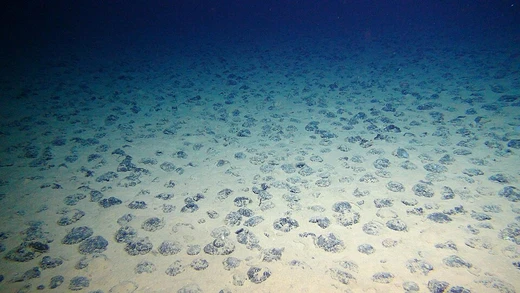
Marine sediment
Deposits of insoluble particles covering most of the seafloor.

Marine sediment, also known as ocean sediment or seafloor sediment, consists of deposits of insoluble particles that have accumulated on the seafloor. These particles originate from land (transported by rivers, wind, and glaciers), from marine organisms, from chemical precipitation in seawater, from underwater volcanoes, and from meteorite debris. Except near mid-ocean ridges, most of the seafloor is covered in sediment, which can range in thickness from a few millimeters to several tens of kilometers. Near the surface, sediment remains unconsolidated, but at depths of hundreds to thousands of meters it becomes lithified (turned to rock).
- Composition sources
- Terrigenous, biogenous, hydrogenous, cosmogenous
- Accumulation rate (coarse particles)
- ~1 meter per thousand years
- Accumulation rate (biogenous oozes)
- ~1 centimeter per thousand years
- Accumulation rate (clay in deep ocean)
- ~1 millimeter per thousand years
- Thickness range
- Few millimeters to several tens of kilometers
- Carbonate compensation depth
- ~4,000 meters
Lore & Background
Marine sediment accumulates slowly across most of the ocean, often taking thousands of years for significant deposits to form. Sediment transported from land accumulates fastest, at about one meter or more per thousand years for coarser particles, while biogenous oozes accumulate at about one centimeter per thousand years, and clay particles in the deep ocean at roughly one millimeter per thousand years. Near the mouths of large rivers with high discharge, sedimentation rates can be orders of magnitude higher. Sediment sources are diverse. Terrigenous sediment comes from continental rocks and soils, transported by rivers, wind, ice, and ocean currents. Biogenous sediment derives from the shells and tests of marine organisms such as foraminifera (carbonate) and diatoms and radiolaria (silica). Hydrogenous sediment forms by chemical precipitation from seawater, such as iron and manganese nodules. Cosmogenous sediment comes from extraterrestrial sources, including meteorite debris. High-energy conditions deposit larger particles; low-energy conditions allow finer sediments to settle. Well-sorted, rounded, quartz-rich sediments like beach sand are considered mature.
Reader's Guide
Marine sediment is significant because it provides a record of Earth's history. The fossilized remains of marine microorganisms within sediments contain information about past climates, plate tectonics, ocean circulation patterns, and the timing of major extinctions. Sediments also provide habitat for a multitude of marine life, particularly microorganisms. The distribution of sediment types reflects ocean conditions. Terrigenous sediments dominate near continents and in inland seas. Carbonate oozes are common in equatorial and mid-latitude regions but dissolve below about 4,000 meters (the carbonate compensation depth), so they are absent from the deepest ocean. Siliceous oozes are common in the south polar region, along the equator in the Pacific, south of the Aleutian Islands, and in parts of the Indian Ocean. Clay is widespread in the deepest parts of the ocean, mostly terrestrial in origin. Sediment is transported from continental margins to the deep ocean by turbidity currents. The deep ocean floor spreads from mid-ocean ridges and subducts accumulated sediment into Earth's molten interior, while molten material returns as lava and hydrothermal vent emissions, sustaining an ongoing cycle. Understanding marine sediment helps scientists reconstruct ancient environments and predict future changes.
Did You Know?
- Sediment thickness on the seafloor ranges from a few millimeters to several tens of kilometers.
- Carbonate oozes dissolve at depths below about 4,000 meters, known as the carbonate compensation depth.
- Clay particles in the deep ocean accumulate at a rate of about one millimeter per thousand years.
- Turbidity currents transport sediment from the continental slope to the deep ocean floor.
Origins and Composition of Seafloor Deposits
Marine sediment encompasses the insoluble particles that settle and accumulate across the ocean floor, drawing from a remarkably diverse set of sources. A major category is terrigenous material—fragments of soil and rock carried from land by rivers, wind-blown dust, and glacial flow into the sea. This material is typically dominated by quartz, feldspar, clay minerals, iron oxides, and terrestrial organic matter. A second major source is biogenic: tiny shells and tests produced by organisms such as foraminifera (building carbonate structures), diatoms, and radiolaria (constructing silica-based tests). Additional contributors include volcanic ash from both land-based and submarine eruptions, iron and manganese nodules that precipitate directly from ocean-bottom water, and even meteorite debris. The resulting composition is highly variable, shaped by proximity to continents, water depth, prevailing ocean currents, local biological productivity, and regional climate. Terrigenous sediments tend to dominate near continental margins and within inland seas, while biogenic oozes prevail in open-ocean regions where their producing organisms are most abundant.
The Carbonate Compensation Depth and Spatial Distribution
One of the most striking features of marine sediment distribution is the phenomenon of the carbonate compensation depth. Although calcite—the mineral from which foraminifera and other near-surface organisms build their shells—is insoluble in shallow seawater, its solubility increases steadily with depth and pressure. At roughly four thousand metres, carbonate fragments begin to dissolve before they can reach the seafloor, meaning that carbonate oozes are essentially absent from the deepest ocean basins. This critical depth is not fixed; it shifts with latitude and water temperature. As a result, carbonate-rich deposits cluster in shallower settings such as the mid-Atlantic ridge, the East Pacific Rise west of South America, the Hawaiian and Emperor seamount chain, and the summits of isolated seamounts. By contrast, siliceous oozes from diatoms and radiolaria thrive in the south polar region, the equatorial Pacific, the waters south of the Aleutian Islands, and broad stretches of the Indian Ocean. Clay, settling everywhere, fills the gaps wherever neither silica- nor carbonate-producing organisms are prolific enough to dominate.
Timescales of Accumulation and the Path to Lithification
Building a meaningful layer of seafloor sediment is, by human standards, an extraordinarily slow process. Across most of the open ocean, it takes thousands of years for even modest deposits to accumulate. Land-derived particles, being coarser, settle at roughly one metre or more per thousand years, though near the mouths of large, high-discharge rivers the rate can be orders of magnitude faster. Biogenic oozes, composed of the delicate shells of microscopic organisms, accumulate at approximately one centimetre per thousand years, while the finest clay particles drift down to the deep ocean floor at around one millimetre per thousand year. Despite these glacial rates, the cumulative effect over geological time is immense: sediment thickness ranges from mere millimetres to several tens of kilometres. Near the surface, these deposits remain loose and unconsolidated. However, once buried to depths of hundreds or thousands of metres, the weight of overlying material and chemical processes cause the sediment to lithify—transforming from soft, granular material into solid rock. This transition marks the boundary between active sediment and the geological record.
The Sedimentary Cycle and Its Scientific Legacy
Marine sediment is not merely a passive archive; it is an active participant in Earth's geological engine. Sediment carried from the land is deposited along continental margins by surface runoff and river discharge, and turbidity currents can sweep it down the continental slope onto the deep ocean floor. From there, the seafloor itself is in constant motion: it spreads outward from mid-ocean ridges and eventually subducts the accumulated sediment back into the planet's molten interior. In a continuous loop, that molten material resurfaces as lava flows and emissions from deep-sea hydrothermal vents, replenishing the system indefinitely. Beyond its role in the rock cycle, sediment is a vital habitat, supporting vast communities of marine microorganisms. When those organisms die and their remains become fossilized, they encode detailed information about past climates, the movement of tectonic plates, historical ocean circulation patterns, and the timing of major extinction events. In this way, the quiet layers beneath the ocean floor serve as one of humanity's most important windows into Earth's deep past.
Frequently Asked Questions
Who is Marine sediment?
Marine sediment is the blanket of insoluble particulate matter that has settled and accumulated across the seafloor. It is the single most widespread surface feature of the ocean basins, draping nearly every region of the deep sea except the immediate flanks of mid-ocean ridges.
What are Marine sediment's powers and role?
Marine sediment acts as the ocean's long-term archive, recording climate shifts, biological productivity, and tectonic activity in layered deposits. Its particles arrive from four main pathways: weathered rock carried in from continents, shells and skeletal fragments shed by marine life, minerals that precipitate directly out of seawater, and (rarely) fragments of extraterrestrial material.
How does Marine sediment's story end?
Over geological time, the weight of overlying layers compacts and cements loose sediment into solid rock such as shale, limestone, or chert. In subduction zones, portions of that rock are dragged back into the mantle, effectively recycling the seafloor and closing the sedimentary cycle.
Why is Marine sediment important?
It is the primary repository for the planet's long-term carbon and climate record, and its thickness—ranging from mere millimeters in young basins to tens of kilometers in mature ones—encodes hundreds of millions of years of environmental change. Understanding its accumulation rates (from roughly one millimeter per thousand years for deep-ocean clay to about one meter per thousand years for coarse, river-fed deposits) lets geologists reconstruct past sea-levels and tectonic histories.
Where does Marine sediment come from?
Terrigenous material is eroded from land and delivered by rivers, wind, and glaciers; biogenous material is the calcareous or siliceous debris of plankton and other organisms; hydrogenous material forms by in-situ chemical precipitation in seawater (limited below the carbonate compensation depth of roughly 4,000 meters); and cosmogenous material arrives as micrometeorite dust.
More in Coastal & Marine Geology 1-21
Spotted an error? Know more?
This is a living reference — every entry is fact-audited, and reader corrections feed straight into our audit queue. Suggest an edit · See this site's audit record