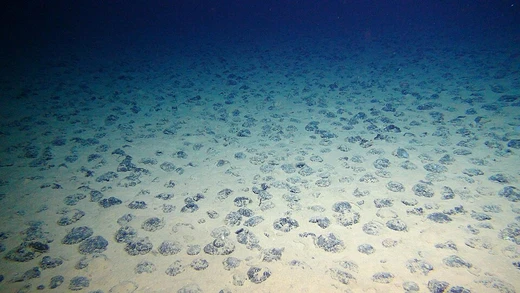
Marine regression
Geological process exposing seafloor during sea level drops.

Marine regression is a geological process in which areas of submerged seafloor become exposed due to a drop in sea level. It is the opposite of marine transgression, where flooding covers previously exposed land. Regressions are significant because they have been linked to major extinction events and changes in Earth's climate and tectonic activity.
- process
- Marine regression
- opposite_event
- Marine transgression
- associated_extinctions
- Permian–Triassic (250 Ma) and Cretaceous–Paleogene (66 Ma)
- related_phenomena
- Glaciation, sea-floor spreading slowdown, formation of Pangaea
Lore & Background
According to one hypothesis, marine regressions may be linked to a slowdown in sea-floor spreading, which reduces the volume of mid-ocean ridges and lowers sea level. This view considers major regressions as part of normal variations in plate tectonic activity, which can lead to episodes of global volcanism like the Siberian Traps and Deccan Traps, in turn causing large extinction events. Evidence of regressions and transgressions appears throughout the fossil record, and these fluctuations are thought to have caused or contributed to several mass extinctions, including the Permian–Triassic extinction event (250 million years ago) and the Cretaceous–Paleogene extinction event (66 million years ago). During the Permian-Triassic extinction, the largest in Earth's history, global sea level fell by 250 meters.
Reader's Guide
Marine regression is a key concept in understanding Earth's geological and biological history. It is not merely a change in coastline but a process that can expose vast areas of seafloor, affecting marine ecosystems and contributing to mass extinctions. However, the article notes that while a major regression could cause shallow-sea organisms to go extinct, mass extinctions typically involve both terrestrial and aquatic species, making it harder to see how regression alone could cause widespread land animal extinctions. Thus, regressions are seen as correlates or symptoms of major extinctions rather than primary causes. The Permian regression may have been related to the formation of Pangaea, as the coalescence of continents could have slightly enlarged ocean basins. During the Pleistocene ice ages, a clear correlation existed between regressions and glaciation, as water locked in ice sheets reduced ocean volume. However, some major regressions, such as the one at the end of the Cretaceous, appear unrelated to glaciation. The concept helps scientists interpret past climate and tectonic events.
Did You Know?
- A cold spell around 6 million years ago was linked to a marine regression and the start of the Messinian salinity crisis.
- Some major regressions, like the one at the end of the Cretaceous, seem unrelated to glaciation episodes.
Tectonic Roots: How Plate Motion Drives Sea-Level Change
A marine regression unfolds when regions of ocean floor that were once beneath the waves become exposed to air as global sea level falls. One prominent hypothesis traces this phenomenon to a deceleration in the rate at which new oceanic crust is generated at mid-ocean ridges. When sea-floor spreading slows, those underwater mountain ranges occupy less volume on the seafloor, and the resulting reduction in basin capacity produces a broad, generalized decline in sea level. Proponents of this view regard major regression episodes not as anomalies but as a natural oscillation within the rhythm of plate tectonic activity. The same tectonic restlessness that modulates ridge volume also drives extraordinary bursts of volcanism, such as the Siberian Traps and the Deccan Traps, whose catastrophic eruptions have been linked to some of the most severe extinction events in Earth's history. In this framework, a regression is not an isolated hydrological event but a visible surface expression of deep mantle dynamics, tying the fate of coastal habitats to the slow grinding of continental plates.
Regressions at the Edge of Extinction
The fossil record is studded with traces of repeated regression and transgression cycles, and paleontologists have long suspected that these sea-level swings played a role in several of the planet's great die-offs. During the Permian–Triassic boundary event, roughly 250 million years ago—the single largest mass extinction ever documented—global sea level dropped by an estimated 250 metres. A comparable regression accompanied the Cretaceous–Paleogene boundary event 66 million years ago. Yet the causal relationship remains contested. While a sharp retreat of shallow seas would clearly devastate marine organisms dependent on those habitats, mass extinctions typically sweep away both aquatic and terrestrial species alike, and it is difficult to construct a mechanism by which a falling coastline alone would trigger the collapse of land-based ecosystems. For this reason, many geologists treat regressions as correlates or symptoms of broader catastrophic processes rather than as primary drivers. In the Permian case, the regression may have been tied to the assembly of Pangaea, whose merging of all major landmasses into a single body could have marginally increased the total volume of ocean basins, but that explanation cannot account for regressions in other geological periods.
Ice, Water, and the Pleistocene Rhythm
During the Pleistocene ice ages, the link between marine regression and glaciation became unambiguously clear. The mechanism is straightforward: as the planet's climate cools, an increasing share of Earth's water is locked into continental ice sheets, removing that volume from the oceans and pulling sea level downward. A much earlier cold interval, roughly six million years ago, paired an advance of glaciation with a marine regression and the onset of the Messinian salinity crisis in the Mediterranean basin, when restricted circulation drove the sea toward near-desiccation. Nevertheless, not every major regression can be attributed to ice. The regression that coincided with the end-Cretaceous mass extinction stands as a prominent counterexample, demonstrating that sea-level fall can arise from causes entirely independent of the cryosphere.
The Twin Cycle: Regression, Transgression, and Deep Time
Marine regression and marine transgression form a complementary pair of geological processes. A regression exposes previously submerged seafloor as sea level retreats, while a transgression does the reverse, flooding land that had stood above the waves. Together they paint a picture of a coastline that is never truly static but perpetually migrating across the continental margin. The physical remnants of these cycles are visible in the landscape today as marine terraces—stepped, emergent coastal landforms that record former shoreline positions. The broader pattern of fluctuation extends across the entire fossil record, with evidence of both regression and transgression appearing in rock layers spanning hundreds of millions of years. One particularly instructive example is the Permian regression, which may have been facilitated by the gathering of all major continents into the supercontinent Pangaea; the coalescence of landmasses would have produced a slight enlargement of ocean basins, lowering relative sea level. Yet this tectonic explanation, while elegant for one episode, cannot be generalized to every regression event in Earth's history, underscoring the diversity of mechanisms at work.
Frequently Asked Questions
What is Marine regression?
Marine regression is a geological process in which global sea level falls and previously submerged seafloor is exposed as new land. It represents the ocean effectively retreating, revealing areas that had been underwater.
What is the opposite of Marine regression?
The opposite event is called marine transgression, where rising seas flood and cover land that had previously been exposed. The two processes act as a natural see-saw of sea-level change across geological time.
How does Marine regression connect to mass extinctions?
Regressions have been linked to two of Earth's most catastrophic extinction events: the Permian–Triassic boundary around 250 million years ago and the Cretaceous–Paleogene boundary at roughly 66 million years ago. The sudden exposure of vast seafloor areas during those sea-level drops is thought to have intensified the environmental stress that eliminated large fractions of marine life.
What causes Marine regression?
Key drivers include the growth of continental ice sheets (glaciation), a slowdown in sea-floor spreading, and the assembly of supercontinents such as Pangaea. Any of these mechanisms can reduce ocean-basin volume or lock water away in ice, pulling shorelines seaward.
Why is Marine regression important to coastal and marine geology?
Regressions reshape coastlines, disrupt marine habitats, and leave behind distinct sedimentary records that geologists use to reconstruct past climates and tectonic settings. Understanding them helps interpret the rock record and contextualualize how future sea-level changes might affect coastal zones.
More in Coastal & Marine Geology 1-21
Spotted an error? Know more?
This is a living reference — every entry is fact-audited, and reader corrections feed straight into our audit queue. Suggest an edit · See this site's audit record